


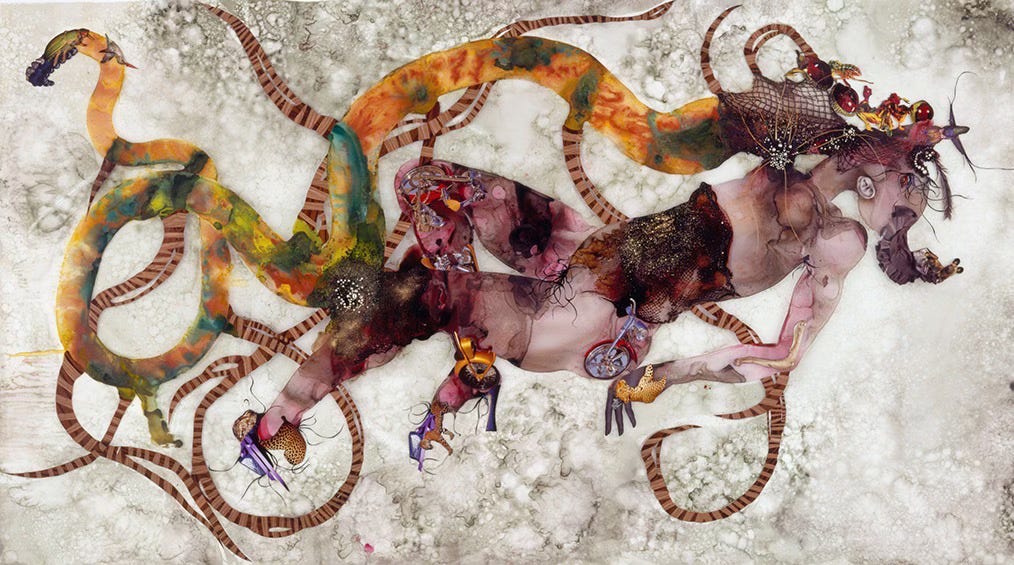
As the snake sheds its final skin and the old cycle closes, we harvest seed for what comes next. This new Moon on February 17 is accompanied by a solar eclipse—an event that many cultures have long read as rupture to the ordinary order, when hidden forces surface and new beginnings demand courage.
What are you stepping into?
What seeds are emerging from the cracks to carry with you?
And what wider music are you attuning with, amid the noise?
Join us for the next Resonance Circle on Sunday, 15 February, 8-10am, to practice a wild fidelity to the unravellings in your life.
(Apologies for the date change as there was a calendar clash).
Please message me to RSVP and receive the location pin.
Mythic resonances and astronomical alignments
Astrologically, Pluto’s recent entry into Aquarius signals a long cycle associated with systemic disruption and collective reorganisation. Whether or not one reads planets as causal agents, they remain potent symbolic lenses through which societies have long interpreted periods of upheaval, rebellion, and reimagining.
Amplified by Uranus stationing direct on February 3, the Aquarian mood coincides — not as proof, but as pattern — with a visible surge in youth-led movements across the Global South. From Nepal and Madagascar to Kenya, Togo, Morocco, Bangladesh, Indonesia, and Peru, Gen Z activists are articulating a shared resistance to corruption, state violence, economic precarity, and futures foreclosed. These uprisings are historically and materially grounded, yet they are also carried by something harder to quantify: a collective affect; a sense that “something has to change.”
Alongside these social pressures, Earth itself is undergoing measurable physical stress. Scientists track increased solar activity, geomagnetic storms, seismic events, and climatic extremes — data that describes a planet in restless motion. Geophysicist Stefan Burns, who publicly documents empirical space-weather data, reports heightened solar storms, radiation events, and electromagnetic fluctuations. Claims that such phenomena directly cause social or psychological change remain speculative. Yet across civilisations and epochs, humans have intuited that cosmic, geological, and biological systems are overlapping stories— different registers of the same unfolding.
Seen through an imaginal lens, these disturbances can be read as supporting Earth and our shedding an exhausted world-order.
On the ground, life registers as more extreme. Fires, floods, storms, outages, displacement. Digital acceleration, AI mutations, relentless information flow. Our nervous systems are under unprecedented strain. A physiological, social, and psychological pressure. Without shared rituals to metabolise shock, intensity collapses inward, registering as anxiety, burnout, insomnia, depression. Care now calls for simplifying input, slowing response, and grounding perception through attunement with place and body.

Eclipses are wild cards, intensifying unpredictability. The 17 February eclipse occurs at the final degree of Aquarius—a liminal point often associated with endings and thresholds. In symbolic astrology, this tipping point is where old forms strain to hold emerging energies. In lived experience, it can feel like pressure breaking through without clear direction — an urgency before clarity.
As a partial eclipse, it will produce a ‘ring of fire’—a fitting portal for the arrival of the Fire Horse energy of the Chinese New Year: unbridled, instinctual, herd-aware, and intolerant of confinement.
The eclipse occurs close to the North Node, orienting us toward future pathways. Conjunct Venus exalted in Pisces, the birthing of this era is tempered by love and guided by the sacred feminine. Venus trines Jupiter exalted in Cancer, amplifying compassion, emotional intelligence, and the Moon’s silvered capacity to hold complexity with care.
Soon after, on February 20, Saturn and Neptune form a rare conjunction at 0° Aries. Astronomically, this is simply two planets aligning from our vantage point. Symbolically, it is associated with moments when collective ideals dissolve and reform; when identity (“I am”) must be renegotiated in the face of uncertainty. Neptune dissolves; Saturn structures. Together, they can evoke both disillusionment and the emergence of new forms. When what was promised cracks, it exposes the blackness that runs beneath civilising structures—hidden tendencies, denied libidinal enigmas, insubordinate fugitivity, and sometimes frightening potentialities.
We don’t like cracks. We rush to seal them and return to normal. Yet cracks are where innovation occurs. They interrupt the fantasy of certainty. As Bayo Akomolafe reminds us, failure and rupture are not errors in the system; they are invitations to experiment with life beyond colonial fields of meaning. When disturbances are tended rather than repaired, new realities can be born.
As Mars forms volatile aspects later in the month, intensities may sharpen— shocks, awakenings, technological shifts, emotional reactivity. All of this is weather — inner and outer — and weather does not ask for answers.
It asks for discernment.
Not the judgment of the head, but a discipline of the sensual heart. Discernment that arises from involvement, from staying close enough to perceive the differences between things. Normalcy, after all, has one persistent aim: to expel the different, the abnormal, the monstrous. It does this by turning difference into a form of control—flattening what is alive, tearing it from the fluid, mythic webs that generate meaning and relation.
While differentiation is necessary for the formation of an ‘I’, when it hardens into a fixed knowledge system, the complexity of life is reduced to intelligible fragments—manageable, measurable, disconnected. Communication replaces communion. Subtle relations go unheard. The vital intelligences that span the cracks—communicating through vibration, rhythm, and resonance—fade from perception. We forget how to sense them. Or worse, we try to optimise them.
There are three common ways we betray cracks:
1. Transformation.
When we insist that disruption must mean something—must be useful, instructive, or yield a payoff—we turn rupture into a doorway with a destination.
My wound is my gift.
What doesn’t kill us makes us stronger.
Breakdown leads to breakthrough.
The crack does not promise progress. It goes nowhere. It teaches nothing in the way improvement narratives demand. Its excess, its leakage, its refusal to resolve disrupts the fantasy of optimisation. It cannot be folded back into a story of advancement as the disruption of the enigmatic is always opaque, foreign, outside law.
2. Romanticisation.
Another betrayal is to aestheticise the break—to turn brokenness into identity, distinction, or moral advantage. This is not naïve; it is political. It makes suffering transactional, about what it can yield: depth, meaning, specialness, exemption.
The broken is beautiful.
My darkness is my depth.
Normal people are boring; wounded ones are interesting.
Healing is for cowards.
Autistic children are superheroes.
The crack is neither beautiful nor ugly. It is the void—the blackness of the world’s radical incompleteness—speaking of what is owed to the many presences that constitute a self. Like death, the crack reveals our debt to the para-ontological: ancestral, microbial, planetary, and galactic agencies that continuously assemble and unmake us. When coherence fails, the crack announces the cost of holding things together.
Whether through illness, symptom, war, or accident, the ache that does not resolve makes us feel. It evokes memory, draws us into unwanted intimacies. How we receive the erotic charge of shock—the emotions it releases, the sensations it awakens—is how the insubordinate wildness of soul quietly constructs itself. Fidelity here is not to meaning, but to rhythm and mystery. The crack teaches a different kind of sensing: not logical, but clair-sensual—a situated, provisional awareness attuned to the erotic, the autistic, the anarchic. The divergent, para-normal and para-noid. If we have the heart to perceive it.
There is nothing romantic about the debt collector.
3. Resignation
The third betrayal is collapse into nihilism.
Nothing matters.
Everything is broken anyway.
Why bother. There is no future so we may as well give up.
This can look like fidelity to rupture, but it is actually abandonment. Resignation treats the crack as a terminal diagnosis rather than an ongoing question. It uses breakdown as justification for withdrawal, for not staying, not responding, not remaining available. The crack becomes the final answer instead of a living tension we must continue to meet.
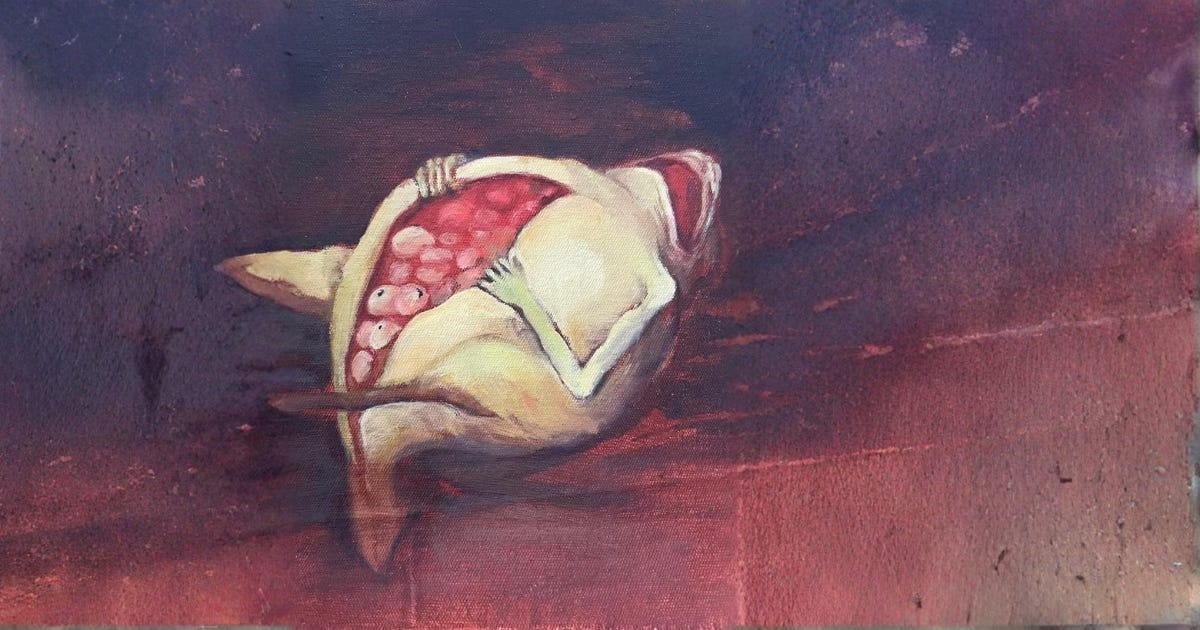
Harvesting the seeds of rupture
We are not separate.
We are not permanent.
We are not the most important thing.
The world does not need to be represented. There it is—already present, already speaking. What it needs is to be perceived with care, and loved better.
Love, here, is not sentiment. Love is the quality of attention we bring to the cracks. With a little more empathy, a little more engagement, a little more patience to stay with what unsettles us, we learn how to shape-shift. Disillusionment becomes a loosening, a necessary unmaking through which subjectivities transform.
Like the Buddhists walking 2,300 miles for peace across America, through every kind of weather, we are asked to remain open. So open it hurts. And then to open further still.
This is the devotion we practice at this new moon.
A fidelity to involvement at the fault lines.
A willingness to encounter disturbance as a discipline of love.
A humility that deepens perception of difference.
Through voice, movement, silence, and shared attunement with immanences moving between, hovering between tension and release, certainty and unknowing, we enter the perceptual field of the heart. In a society hungry not only for community but for meaningful presence, resonating with each other—human and more-than-human— makes soul. We participate—sensitively, imperfectly—in the ongoing making of a world that holds us.
The seeds we harvest are not claimed as power, but recognised as consequences of how—and how carefully—we choose to meet the world.
Message me now to join the next Resonance Circle.
The distinction between the three betrayals of cracks really clarified something for me. I've definitely fallen into that transformation trap - wanting every rupture to yield some lesson or payoff. It makes sense that fidelity to involvement at the fault lines means staying with the disturbance without collapsing it into optimizaton narratives. Sits differently than most eclipse takes tbh.